May we use cookies to track your activities to serve you better? We take your privacy very seriously. Please see our privacy policy for details and any questions.
Region


Tilt and turn windows are everywhere in Europe and Asia-Pacific. They define modern homes and renovation projects. Open inward for full ventilation. Tilt for controlled airflow. Practical, versatile, and widely adopted. Yet integrating motorized shading into this window type has always been complex.
“This was a segment in window covering where motorization remained a challenge. And the market for tilt and turn windows is still growing.”
- Jochem Nijland, Product Engineer at Coulisse
That challenge became the starting point. Because what seems straightforward at first quickly reveals its constraints. Limited space. Moving parts. The need to maintain full access to the window handle. Every millimeter matters. Existing solutions approached the problem in different ways. Some used tensioned cables to motorize movement. Others fixed the motor inside the head rail, limiting how the blind could move. Controls were often placed on the frame itself, not always practical for higher installations.
At Coulisse, the question was different. Not how to adapt existing systems. But how to rethink the entire approach. The starting point combined two principles. A tensioned system already proven in our range. And a motorized frame concept that had yet to be fully realized.

Smart Frame began in December 2022. Not with a formal brief, but with an idea. Bas Klein Tuente, Engineering Manager at Coulisse, sketched a concept for a tensioned click-in frame. The first prototype was rough. Jochem still has it. But it proved the principle. What followed was 2.5 years of development. Around ten prototypes. Each iteration revealing new constraints. Each solution creating the next challenge. The position of the motor changed. The motor itself changed. Every adjustment triggered a chain reaction. Axis positions. Gear rack placement. The shape of the motor head.
“I remember very clearly a moment where the design didn’t seem to work. But technically, it had to. I kept going until it did. That moment felt like a real relief.”
- Jochem Nijland, Product Engineer at Coulisse
The breakthrough came with a fully functional prototype. Built from 3D-printed parts and a self-assembled motor. It moved. Precisely and reliably. After 1.5 years, the core concept was proven. But another year followed. Refining materials. Developing the assembly process. Aligning with manufacturing partners. Finalizing documentation. From first idea to market. 2.5 years.

In many motorized systems for tilt and turn windows, the motor remains fixed while the blind moves around it. Smart Frame takes a different approach. The motor moves with the rail. Traveling along gear racks integrated into the side profiles. A mechanism that required a complete rethinking of how motion is generated and controlled within a frame.
This enables full top-down bottom-up functionality within the window. The blind can be positioned exactly where needed, while the handle remains accessible at all times. In dual-motor configurations, where both top and bottom rails are independently controlled, synchronization becomes critical. Here, the solution is mechanical. The geometry of the gear rack system ensures both rails move in perfect alignment. Drift is not something the system needs to correct. It is something the system prevents. Smart Frame is protected by patented technology.
“Unique is that we can create a true top-down bottom-up system inside a frame. What makes Smart Frame different is that the motor itself moves with the blind. That required a completely new approach.”
- Jochem Nijland, Product Engineer at Coulisse

The first Smart Frame prototype used the smallest motor in the Motionblinds range. It made sense. Limited space calls for minimal components. But testing quickly revealed its limits. The motor struggled with the resistance of the tensioned system, especially at larger sizes. The team moved to the CM-52, based on the efficient CM-45 platform. More power. More stability. But also new constraints. A larger motor impacts system dimensions. Every gain introduces a trade-off.
“We started with the smallest motor. Then we saw it wasn’t strong enough. Moving to a larger motor meant redesigning everything around it. That is the reality of development. Every decision creates the next challenge.”
- Jochem Nijland, Product Engineer at Coulisse
The solution looked ahead. The motor head was designed to accommodate future motor variations. The same architecture allows for a smaller motor in the future, reducing development time when that moment comes. The CM-52 is battery-powered. A solar panel provides continuous charging, with USB-C as backup. To validate endurance, the system was tested across multiple window sizes and configurations. All tests were performed without solar input. Under normal use, the battery operates between six months and a year without solar charging. In real installations, solar energy typically carries the system through an entire winter using energy stored over summer. No wiring. No manual recharging.

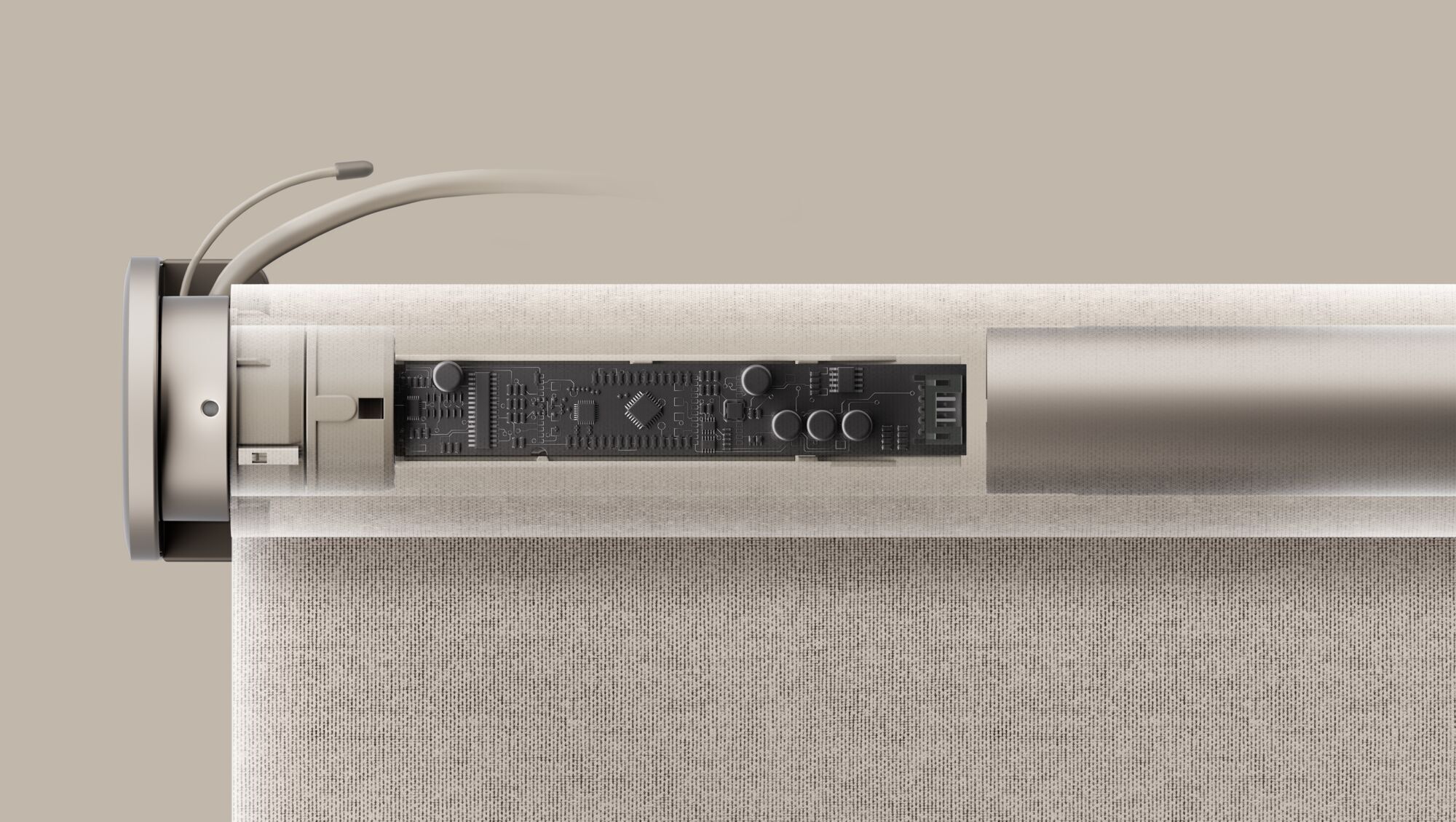
One of the most demanding aspects of Smart Frame was the interface. The standard Motionblinds motor is round. Smart Frame required everything to fit within a rectangular head rail. Every component had to be redesigned. Buttons were repositioned. The LED indicator relocated. The antenna re-engineered as a flat chip, functioning through multiple layers of plastic. When signal strength proved insufficient, the team introduced a precisely positioned opening in the casing. Result. A signal range of up to 50 meters.
“There is a lot hidden behind this interface. Antennas. Sensors. Components you would not expect from the outside.”
- Jochem Nijland, Product Engineer at Coulisse
A lux sensor was later integrated. Measuring light intensity in real time. Adaptive shading is currently in development. A temperature sensor adds another layer of intelligence. When temperatures behind the glass exceed safe levels, the system responds automatically. The frame opens slightly to create airflow. Once cooled, it returns to its previous position. No input required. Technology that quietly manages itself. And disappears into the window.
Existing solutions either fixed the motor in the frame, limiting blind movement, or used cable tension systems with controls that were not always practical for higher windows. Smart Frame combines a moving motorized rail with a tensioned system and full smart home integration. Bringing these elements together required a complete rethink of how motorization works within a tilt and turn window.
Three patents protect Smart Frame. They cover how the motor is integrated into the head rail and how that motorized rail interacts with the gear racks inside the side profiles. This mechanism enables controlled movement, supports dual-motor synchronization, and allows for top-down bottom-up functionality within the frame.
The solar panel is permanently connected and continuously charges using ambient light. Testing on a standard-size window confirmed that the system can operate throughout an entire winter using energy accumulated during summer. USB-C charging is available as a backup, though in most installations, manual recharging is rarely required.
Smart Frame includes both a temperature sensor and a lux sensor. If internal temperatures reach a critical level, the system automatically opens slightly to create airflow and reduce heat buildup. Once the temperature returns to a safe range, the system returns to its previous position. No user interaction is required.
Smart Frame is compatible with most glass types, including single, double, coated, and tinted glass. Triple glazing is not supported, as the solar panel cannot generate sufficient charge through it.
Yes. Each Smart Frame includes a manual control button on the head rail, allowing the blind to be operated without an app, internet connection, or remote.
Smart Frame is built on Coulisse’s existing tensioned system, which is designed for these fabric types and sizes. Larger fabric folds would require a deeper frame, which would interfere with window handle clearance. The selected fabrics support both the technical performance and the slim design of the system.
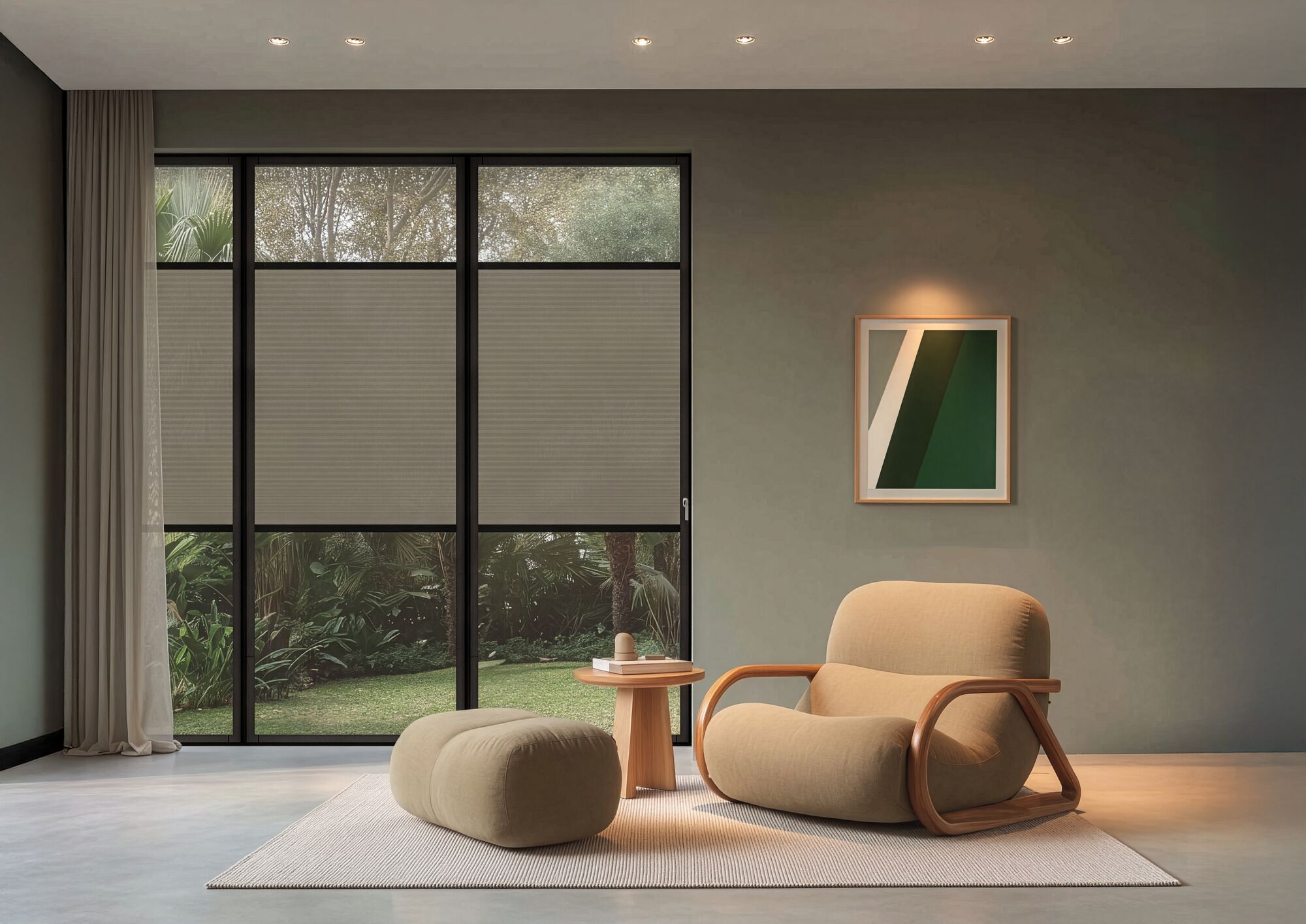
The complete product overview. Including installation, motor options, fabric compatibility, and smart home integration.
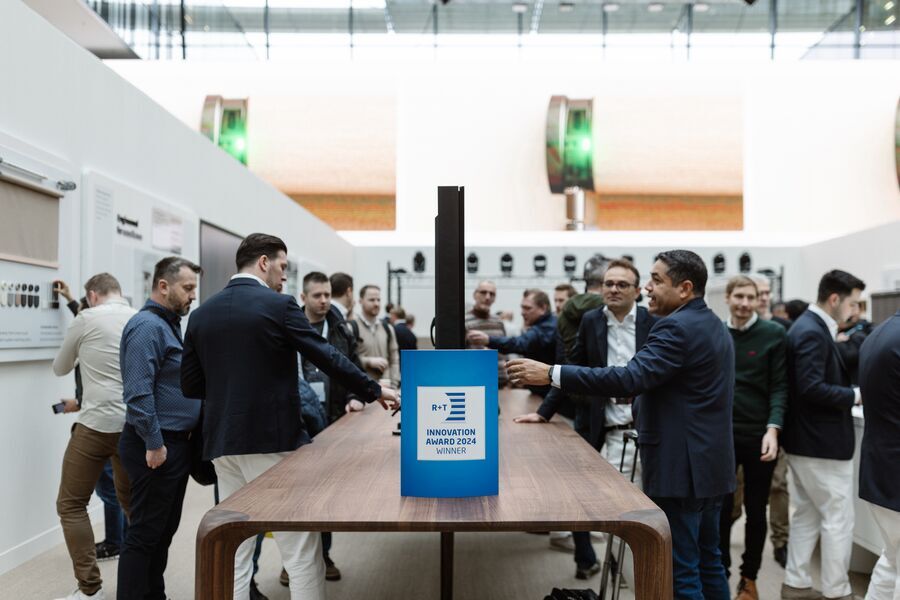
R+T Innovation Award 2024. BBSA Excellence Award 2026. Independent recognition that reflects the engineering behind Smart Frame.